Official Technical Specifications - VA250 Car Project
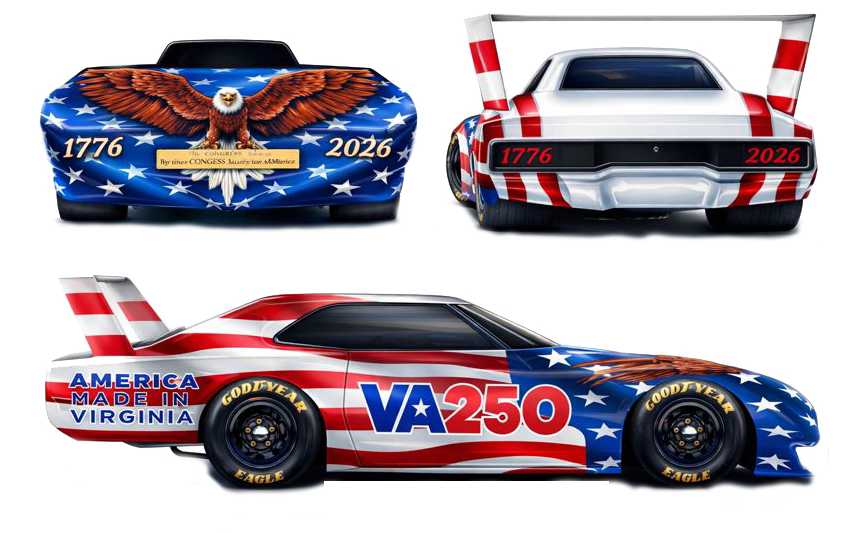 Program Overview
- Record Achieved: 253 MPH Stock Car Land Speed Record
- Date: March 23, 2026
- Driver: Tommy Hurley
- Builder: Joey Arrington
- Educational Partner: University of Virginia Motorsports
- Sanctioning / Technical Partner: International Hot Rod Association
- Run Location: Kennedy Space Center Shuttle Landing Facility
- Program Purpose: Honor America’s 250th Anniversary
Car Chassis and Structure
- Purpose-built land speed stock car chassis
- Reinforced safety cell with integrated roll structure
- Composite and steel construction optimized for rigidity and high-speed stability
- Designed for sustained straight-line operation at extreme speeds
Aerodynamics
- Wind tunnel validated aerodynamic profile
- Body design optimized for drag reduction and directional stability
- Emphasis on crosswind control and surface stability
- Custom aerodynamic solution tailored for Space Florida conditions
Powertrain & Drivetrain
- High-output competition engine configuration
- Engineered for sustained high-load, high-speed operation
- Purpose-built high-speed drivetrain components
- Reinforced transmission and driveline systems
Wheels, Tires, Brakes
- High-speed rated racing tires for land speed competition
- Custom wheel configuration optimized for straight-line stability
- Competition-grade braking system for controlled deceleration
Safety Systems
- Full roll cage and reinforced driver containment structure
- Fire suppression system
- Multi-point racing harness and competition containment seat
- Designed to meet land speed racing safety protocols
Data and Telemetry
- Integrated data acquisition systems
- Real-time monitoring of speed, stability, and vehicle systems
- Post-run data analysis for engineering validation
Engineering and Education
- Active participation by University of Virginia Motorsports students
- Student involvement in aerodynamic analysis and data review
- Real-world STEM platform tied to America’s 250th Anniversary
Additional technical details available upon request.
Technical Media Kit — Record Speed: 253 MPH
A naturally aspirated, NASCAR-derived stock car built in Martinsville, Virginia, attempting to reset the NASCAR stock car land speed record during America’s 250th anniversary.
 Executive Summary
 Executive Summary
The VA250 Car Project is a purpose-built land speed stock car program designed and built in Virginia to challenge the stock car land speed record. On March 23, 2026, the project achieved that goal when the car reached 253 MPH at the Kennedy Space Center Shuttle Landing Facility.
Powered by a NASCAR-derived engine and built by Joey Arrington, the VA250 car continues a motorsports legacy connected to previous Arrington-powered record-setting efforts while creating a new chapter for America’s 250th anniversary.
Historical Context
1971 marked the first NASCAR stock car land speed record using a Dodge Daytona. In 2007, an Arrington-built engine reset the record to 244 mph. The VA250 project continues this lineage during America’s 250th anniversary year.
Vehicle Overview
Chassis 2006 Ronnie Hopkins NASCAR chassis
Body Inspiration 1969 Dodge Daytona Charger
Weight (w/o driver) ~3,000 lbs
Record Speed: 253 MPH
Cape Canaveral
Runway 3 miles long, 300 feet wide (concrete)
Engine Specifications
V8 naturally aspirated small-block, 358 cu in (4.185″ x 4.185″), targeting ~1,000 horsepower at ~9,500 RPM. Fuel: 112 leaded. Cooling enhanced with Liquid Performance additive. Engine designed for ~40 seconds of sustained full-load operation.
Drivetrain & Gearing
Tex Powell four-speed transmission with 2.90 rear gear. Record speeds: 1st 90 mph, 2nd 130 mph, 3rd 170 mph, 4th 250 mph.
Aerodynamics & Stability
Rear wing with dual vertical stabilizers inspired by NASCAR wing cars. Design emphasizes straight-line stability over downforce.
Safety & Data
NASCAR-approved roll cage, fire suppression, driver containment systems. Telemetry includes RPM, front/rear wheel speed, and slip analysis.
Media Contact
VA250 Car Project | va250carproject.com | Media: press@va250carproject.com